


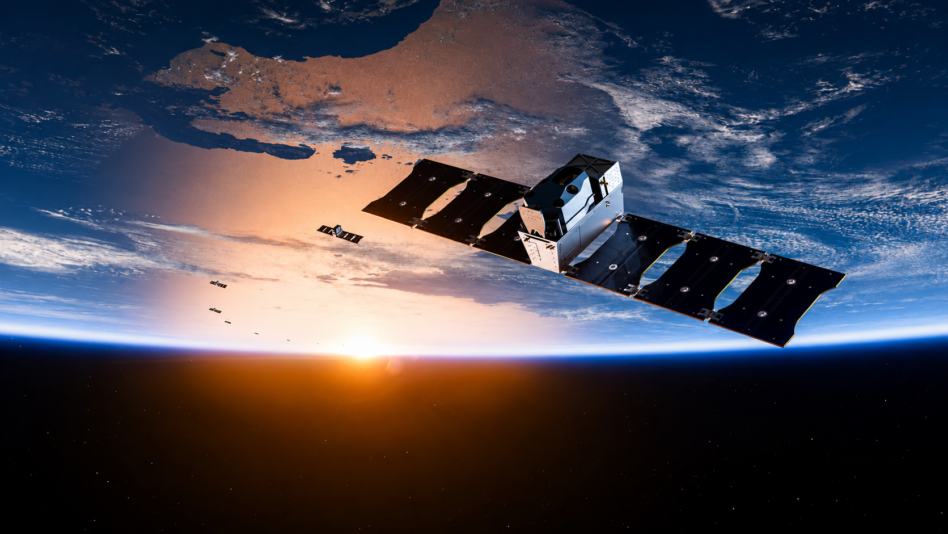
PARIS, FRANCE—Very rarely can someone offer you the best of both worlds, but Hydrosat’s newest constellation claims to do just that.
The thermal infrared EO company today unveiled its next-gen satellite constellation—dubbed Osiris—which is designed around an upgraded payload capable of collecting higher-resolution imagery over a wider area compared to the company’s VanZyl-1 and -2 satellites in orbit today. The first two upgraded sats are expected to launch next year.
“It’s VanZyl-2 on steroids,” Hydrosat CEO Pieter Fossel told Payload. “Usually, you get to do one or the other—swath or resolution. The Hydrosat team has been able to accomplish both at the same time.”
Two for one: Each Osiris sat will carry a payload consisting of five integrated sensors:
- One long-wave infrared imager capable of capturing imagery at 25-m resolution over a 160-340km swath;
- Four visible near-infrared sensors collectively capable of imaging as low as 10-m resolution.
Hydrosat plans to fly Osiris in an always-on configuration, capturing stripmaps of the planet as it flies overhead, and delivering those images into its analytics product—called the Discovery Platform—where customers can spot changes day-to-day over their selected sites.
Build or buy: Hydrosat isn’t waiting for the new sats to come online to start serving customers. The thermal data gathered so far by Hydrosat’s VanZyl sats has been a boon for defense customers, who have taken advantage of these images to conduct ISR campaigns, including a sort-of night watch from orbit.
Thermal sensors don’t discern between day and night, so Hydrosat’s thermal imagery can easily spot things like troop movements, and power usage under the cover of darkness. The VanZyl sats can offer customers 30-m resolution in visible near-infrared, and 70-m resolution on the long-wave.
Those capabilities have won Hydrosat service contracts with major government organizations:
- In June, Hydrosat was awarded a NASA CSDA contract.
- In July, the company won a stage 2 NRO contract, expanding its work with the agency, which began in 2023.
- In August, the company received an award under the SpaceWERX STRATFI program to continue developing its thermal infrared capabilities.
But Hydrosat isn’t only in the business of selling data. The company has also started offering its next-gen infrared payloads to customers looking to add the capability to their own EO constellations. Hydrosat announced an MoU last week with the government of Kazakhstan, which proposed integrating Hydrosat’s payload and AI analytics into a Kazakhstan government spacecraft.
Fossel told Payload that more hardware sales are potentially on the horizon, from an increasingly commercial mix of customers.
“We’re doing about 40% pure commercial [by revenue]…[but] these ratios are going to change,” Fossel said. “Our commercial business has been consistently delivering growth quarter after quarter, year after year, for the last three years, and we expect that to continue.”
MP Space Raises AUD $23M to Scale Satellite Battery Manufacturing
MP Space’s batteries launched for the first time last week with an undisclosed customer on SpaceX’s Bandwagon-5 mission, and already the company has orders to support 500+ spacecraft.

Colare Raises $2.5M to Expand its Hardware-Focused Hiring Platform
Colare’s technical-assessment platform maps the requirements of a role, and recreates decisions future engineers could face on the job.

Inside Starburst’s First Flight, and Portal’s New Bothell Office
“I feel like 80% success now,” CEO Jeff Thurnburg said. “But honestly, to get this far this fast, I’m tempted to call it 100%.”

Exclusive: EraDrive Lands $13M DoD Award For Autonomy Module
EraDrive won a $13M DoD award, under which the Space Force will buy an undisclosed number of the company’s Era-Node vision-based autonomy modules.

PARIS, FRANCE—Isar Aerospace became the first European launch startup to reach orbit less than two weeks ago, and already the market is demanding more.
Launch integrator SEOPS announced a multiple launch service agreement with Isar yesterday covering five dedicated Spectrum launches between 2028 and 2030. The launches will fly from Isar’s launch site at Andøya Space Center in Norway, as well as its launch pad in Nova Scotia, Canada, which is still under development with the help of partner Maritime Launch Services.
The launches will be part of SEOPS’ growing Waymaker program, which is intended to provide more rideshare availability to the market as SpaceX ramps down its Transporter missions.
Keep reading