


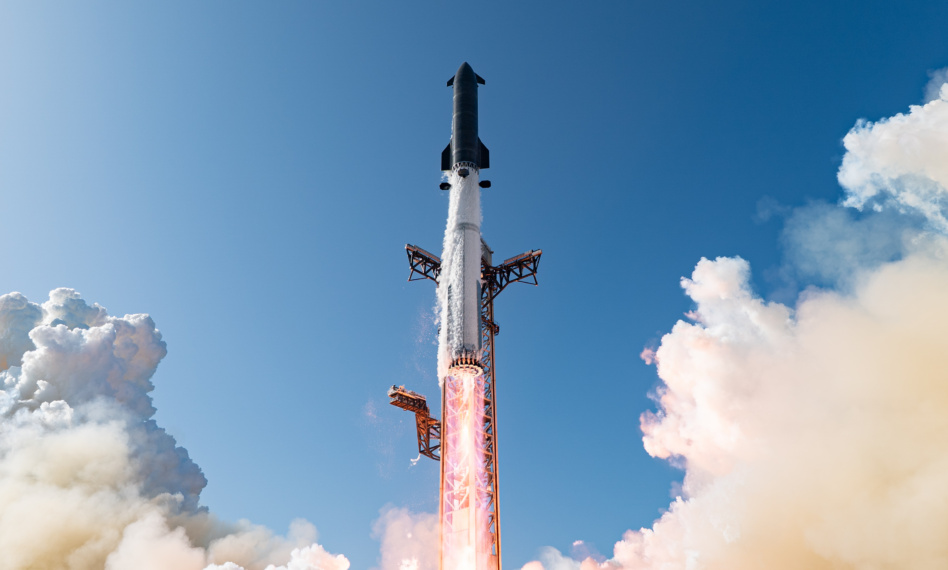
SpaceX flew the 13th test flight of its Starship rocket Friday evening, lifting off from Starbase at 6:51 pm EDT and ending with the first intact Starship put in the water.
It was the first Starship flight since the company’s record-breaking IPO in June. A Thursday attempt was scrubbed for cloud cover that would have blocked heat-shield imaging.
Hot to go: The ship splashed down in the Indian Ocean ~65 minutes after liftoff, flipped upright, then tipped over and floated (versus exploding). It continued transmitting over Starlink while SpaceX drones inspected it.
During the flight, SpaceX pushed Starship harder than ever:
- The vehicle withstood a higher dynamic pressure ascent than any prior flight, trading tile stress for payload capacity;
- It featured 18,000+ ceramic tiles that came through reentry temps of more than 1,400 degrees Celsius;
- The vehicle remained intact during a descent from over Mach 20 to subsonic.
CEO Elon Musk said on X that SpaceX will attempt a tower catch on the next flight, absent problems in data review.
Bolder than ever: SpaceX debuted Starship V3 in May, when booster engines failed to relight, the ship shut down an engine early, and SpaceX scrapped the in-space relight demo.
Flight 13 fixed the relight issue, with a Raptor firing ~14 seconds in space. The booster fared worse. All 33 engines lit at liftoff, then fired again for the high-thrust portion of the boostback burn, a first for a V3 booster. The second burn ended early. Only 5 of 13 engines fired during the landing burn, which SpaceX called a “hard splashdown.”
Bird watching: On Friday’s flight, Starship deployed 20 Starlink V3 sats, which were the first working birds after six flights of dummy payloads. SpaceX contacted all 20 over RF and laser links during ~20 minutes of tests, including solar array and antenna deployment. Six carried cameras trained on the heat shield to study return readiness. All demised on reentry, as expected on a suborbital trajectory.
What’s next: SpaceX President and COO Gwynne Shotwell told CNBC in June that a clean Flight 13 could make Flight 14 the first orbital attempt. No Starship has completed an orbit in 13 flights. SpaceX is building two Starship pads in Florida.
Starship is central to SpaceX’s long-term plans:
- It will increase the deployment cadence of SpaceX’s V3 Starlink constellation;
- It’s planned to dock with Orion on Artemis III, and land astronauts on the Moon on Artemis IV;
- It will also open the door for SpaceX to debut Starmind, its orbital data center constellation.

RATLOG Wants to Cut ~90% of a Rocket Engine’s Parts
The heavy-lift rocket startup debuted on Y Combinator as part of the Fall 2026 batch.
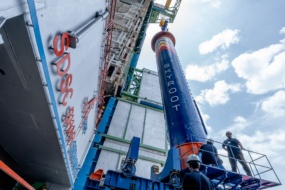
Reflect Orbital Buys Two Skyroot Aerospace Launches
Reflect Orbital announced the purchase of two launches today from Indian launcher Skyroot Aerospace.

DOT Proposes Changes to Part 450 Licensing Rules
On Tuesday, Transportation Secretary Sean Duffy announced five proposed FAA rules aiming to streamline and modernize commercial space launch and reentry regulations.
Skyrora Shifts Orbital Launch Timeline to 2030
First-mover advantage isn’t all it’s cracked up to be—at least, that’s the thought process for UK launcher Skyrora.
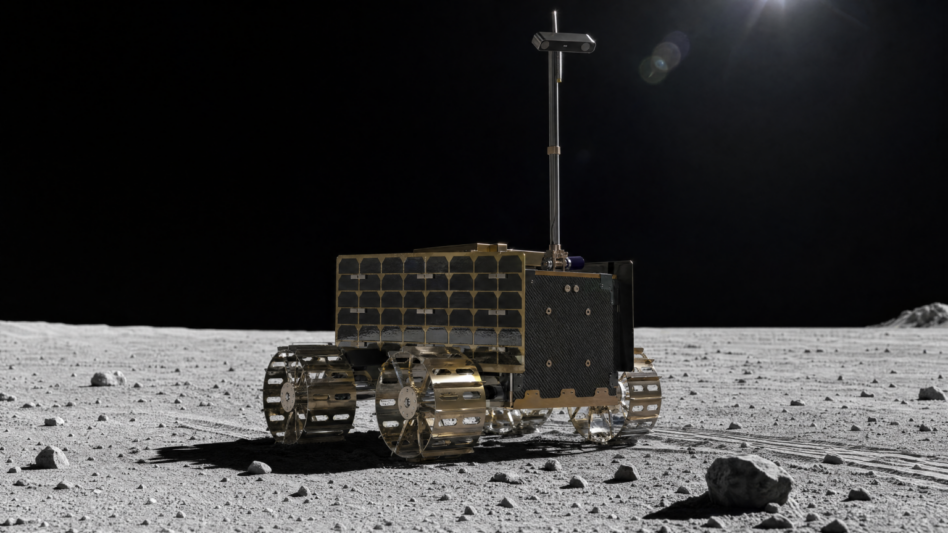
ispace-Europe is heading to the Moon following a €65M (~$74M) commitment from ESA for Europe’s first lunar polar ice exploration rover mission.
The award is a Phase 2 contract for MAGPIE—the Mission for Advanced Geophysics and Polar Ice Exploration—which will fully fund the remaining development of the rover and payload as well as manufacturing, testing, transportation, lunar surface operations, and delivery of scientific data.
“ispace-Europe is the industrial prime for ESA’s first lunar surface exploration mission—a role that would have been traditionally assigned to a large system integrator,” ispace-Europe CEO Julien-Alexandre Lamamy told Payload over email. “MAGPIE is the first mission under ESA’s Small Exploration Missions (SMEX) program, whose purpose is to perform high-impact exploration missions with a higher risk tolerance for smaller budgets and faster implementation, led by small space companies.”
Keep reading