


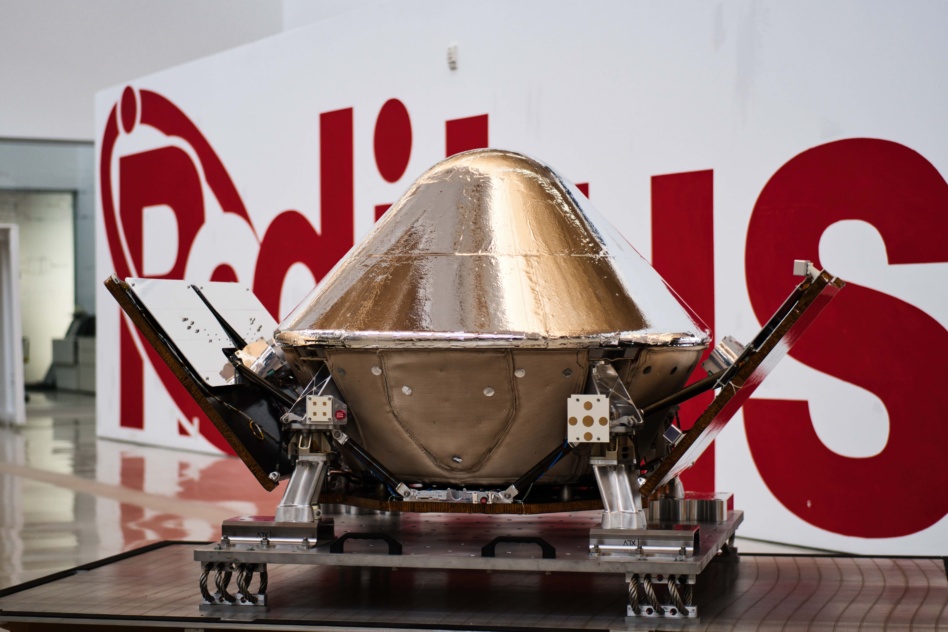
Reditus Space is ready to fly its first reentry mission. The startup, which emerged from stealth in December, announced today it completed development of its first reentry spacecraft—called ENOS—which is scheduled to fly its debut mission this fall.
ENOS is the latest in a string of newly developed reentry vehicles targeting the nascent but growing market for Earth-return capabilities. As the ISS winds down operations in the 2030s, more payload operators have started to look to free-flying reentry vehicles to conduct in-orbit science on the road to eventual, full-scale, in-space manufacturing operations.
Bring it home: To compete in this increasingly crowded market, Reditus is attempting to make a vehicle that can be flown to space and back multiple times—and officials are hoping to benefit from the same favorable economics that have opened up the launch market to high-cadence, affordable flights.
“In the long term, our intent is to make [reentry] as regular an occurrence as launch,” Reditus CEO Stef Crum told Payload. “So that, for all intents and purposes, means that there is a system reentering multiple times a day.”
That feat is easier said than done. Many of today’s reentry vehicles rely on heat shields that are strong enough to withstand the violence of Earth return, but which cannot withstand those forces a second time. To make this possible, Reditus is developing a proprietary manufacturing system to ensure that its heat shield can survive multiple missions.
Flying the coop: After launching in the fall, ENOS is expected to spend two months orbiting the Earth, before reentering the atmosphere at speeds as high as Mach 29. The vehicle is targeting a splashdown and recovery off the coast of Florida in December, according to Crum.
Fully loaded, ENOS weighs in at 200 kg—40 kg of which is payload mass. While Reditus’ end goal is full reusability, this first flight will be largely single-use, with much of the company’s hardware—solar panels, radiators, external sensors, antennas, etc.—separating before reentry.
On later iterations, Reditus plans to increase the payload capacity to 60 kg, as well as upgrade the vehicle’s design to ensure more systems can be protected through reentry, before being refurbished and reflown.
The goal is to make the economics of flying up and back more attractive to potential customers, and Reditus more competitive as a result.
“As we get more dialed-in on the full reusability system—and as we start approaching more a model of fleet operations—at that point we will be able to amortize the cost of the vehicle over multiple missions,” Crum said. “At this stage we’re very much still making money out of every single flight—with the exception of this first one, of course.”
Reditus plans to fly V2 of ENOS in the middle of 2027.
HawkEye 360 Turns its RF-Sensors to Orbital Targets
The DoD wants to better understand what’s going on in orbit. HawkEye 360 ($HAWK) has the inside scoop.

Nebex Partners with Thrusters Unlimited to Unlock $700M for Mexico’s Space Ecosystem
The capital will fund EO, telecoms and other strategic capabilities, according to Nebex.
Transporter-18 Tests the Building Blocks of Orbital Data Centers
Few rideshares come with a theme, but SpaceX’s Transporter-18 had one: getting power to compute in orbit.

Satlyt Raises $8M Seed to Expand Its Virtual ODC Network
Satlyt was founded in 2024 by Afullo, an alum of SpaceX and Google who spent years trying to convince both companies to invest in in-space edge computing opportunities.

Reflect Orbital, the startup attempting to provide on-demand sunlight using in-space mirrors, received a license from the FCC last week to fly its first in-space demo satellite—named Eärendil-1.
The debut flight, which is scheduled to fly this year, will attempt to validate Reflect Orbital’s core technology—an 18 m film reflector that will try to beam sunlight down to Earth.
Rubber glue: The mission—and Reflect Orbital’s broader plan to launch a constellation of 50,000 additional mirrors—has drawn the ire of astronomers who argue that the hardware will have long-reaching effects on their ability to conduct space science from terrestrial telescopes.
Keep reading